
How Merchants Can Verify Transfer Slips and Reduce Fake Slip Risks
Many merchants are increasingly concerned about fake transfer slips, incomplete payments, and verifying transactions during busy hours. This article explains practical ways shops can reduce mistakes and improve confidence when accepting QR payments.
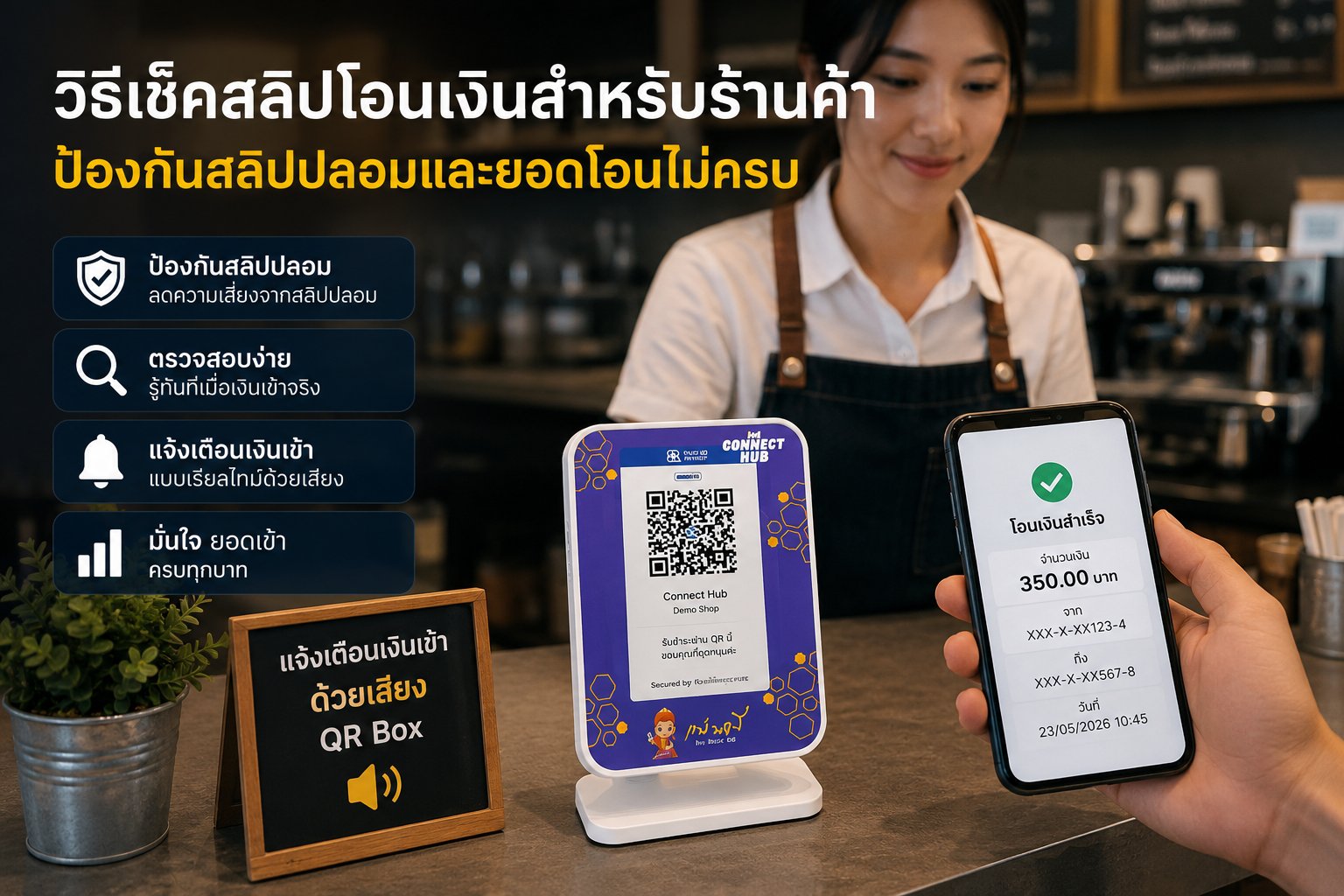
Modern Merchants Are Not Only Concerned About “Seeing a Slip” — They Want to Know the Money Actually Arrived
Today, QR payments have become one of the primary payment methods for restaurants, cafés, pharmacies, market shops, and SMEs across Thailand.
Although most customers complete payments honestly, many merchants are becoming increasingly concerned about:
- Fake transfer slips
- Incomplete transfer amounts
- Customers showing slips and leaving immediately
- Staff missing payment checks during busy hours
- Uncertainty about whether money actually arrived
Especially during busy periods, relying only on screenshots of transfer slips may no longer be sufficient for many businesses.
Why Relying Only on Transfer Slips Can Create Operational Mistakes
In real-world environments, front-store staff often handle multiple tasks simultaneously — taking orders, serving customers, handling payments, and managing queues.
During busy periods, common mistakes may include:
- Reading the wrong amount
- Missing account details
- Customers showing old slips
- Actual transfer amounts not matching the claimed amount
- Edited or manipulated screenshots
Because of this, many merchants are looking for better ways to confirm that payments have truly arrived rather than depending solely on screenshots.
Many Shops Now Use Audible Payment Alerts as an Additional Verification Layer
Today, many merchants use audible payment notification systems to immediately recognize when money successfully arrives in their accounts.
This approach helps businesses:
- Hear confirmation when money arrives
- Reduce missed transfers during busy periods
- Reduce the need to constantly monitor phones
- Allow multiple staff members to hear confirmations simultaneously
- Improve confidence during payment handling
For many businesses, real-time payment alerts provide greater operational confidence than checking transfer slips alone.
Payment Alert Systems Are Becoming Part of Daily Store Operations
In the past, many businesses relied entirely on manually checking transfer slips on mobile phones. However, as QR payment usage increases, this workflow can create more operational pressure on staff.
This is especially true for shops with:
- Large customer queues
- Multiple bank accounts
- Several staff members
- Noisy environments
- High daily transaction volume
Because of this, many businesses now add audible payment alert systems as operational support tools to simplify payment verification.
Many Merchants Prefer Simplicity Over Complex Systems
While there are advanced POS and integrated systems available in the market, many businesses mainly want:
- Immediate confirmation when money arrives
- Reduced operational mistakes
- Easy workflows for staff
- Less dependence on constantly checking phones
- Fast and simple deployment
Because of this, standalone payment alert systems such as QR BOX are becoming increasingly popular among restaurants, cafés, market shops, and SMEs.
Reliable Payment Confirmation Improves Long-Term Merchant Confidence
In reality, most merchants do not necessarily need the most complicated systems. Instead, they want solutions that simplify daily operations and reduce payment-related mistakes.
For many businesses, audible payment alert systems are becoming important operational tools that improve confidence when accepting QR payments, especially during busy business hours.
Explore Related Information
If you are evaluating whether Connect Hub fits your business, you can continue with the product page, comparison page, and more case studies.
Comparison Page
Compare normal phone sound, Bluetooth speaker approaches, and Connect Hub.